How to dispute a charge by phone: credit card vs debit card
We called Chase, Capital One, Discover, PNC and Wells Fargo on the same Saturday evening and asked how a dispute works. All five put us through to a person. Here's what they said, what federal law actually requires for credit and debit cards, and the 60-day deadline three of the five representatives left out.
 Nick Khami / / number verified / 9 min read
The short answer: to dispute a charge, call the number on the back of your card and tell them the merchant, date, amount and what went wrong. Then, for a credit card, also send a written dispute within 60 days of the statement that first showed the charge. The CFPB's answer to How do I dispute a charge on my credit card bill? says to call the card company right away, and that "to protect your rights" you must also send a written billing error notice "within 60 calendar days after the charge appeared on your statement."
Step by step:
- Try the merchant first if it's a problem with what you bought. Chase and Capital One both say this on their dispute pages, and write down who you spoke to and when.
- Wait for the charge to post. Banks generally can't dispute a pending charge. Chase's representative put it this way: you can dispute "as long as it's not pending."
- Call the number on your card, or use the app. Have your card number ready, plus the last four of your Social Security number: Chase's and Discover's menus asked for it.
- Say "dispute" at the menu. Chase has a "press three" option, PNC a "dispute a transaction" menu, Discover a billing disputes team.
- For a credit card, follow up in writing at the card company's billing error address or web form, within 60 days.
- Keep the reference number and a copy of everything you send.
Why the letter matters: a phone call alone may not trigger your legal rights. Discover's own cardmember agreement says: "You may call us, but if you do we are not necessarily required to investigate any potential errors and you may have to pay the amount in question." That's the standard federal billing rights notice, so your card agreement likely says the same.
We called five banks' card lines on Saturday, October 24, 2026, between 6:22 and 6:39 pm Eastern, with call4me asking the questions. We don't hold any of these cards, said so, and gave no card or personal details.
What happened when we called five banks
| Bank | Number we called | Person reached | What they asked for first |
|---|---|---|---|
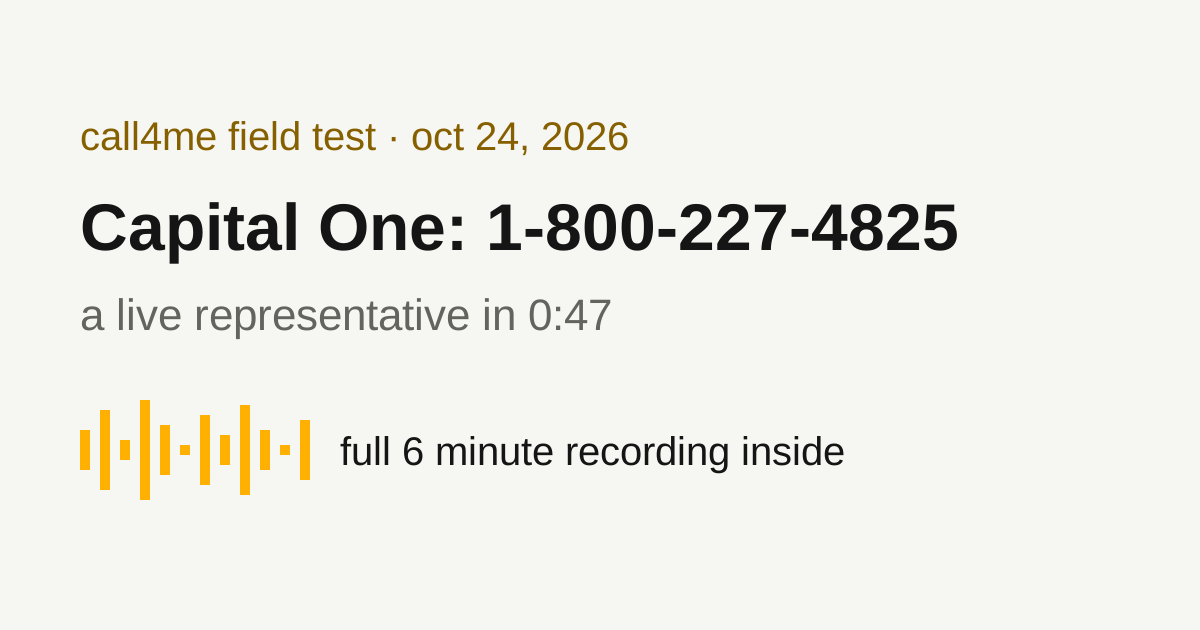
| Capital One | 1-800-227-4825 | 0:47 | Card number, then a phone number |
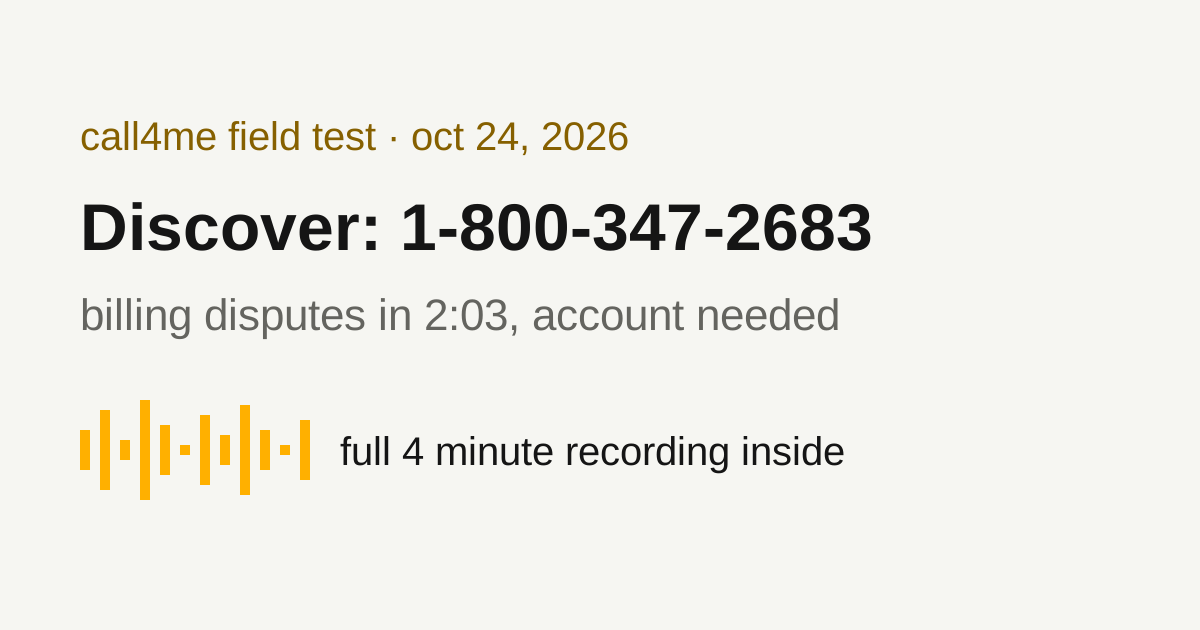
| Discover | 1-800-347-2683 | 2:03 | Last 4 of SSN, then card number |
| Chase | 1-800-432-3117 | 2:14 | Card number, then full SSN |
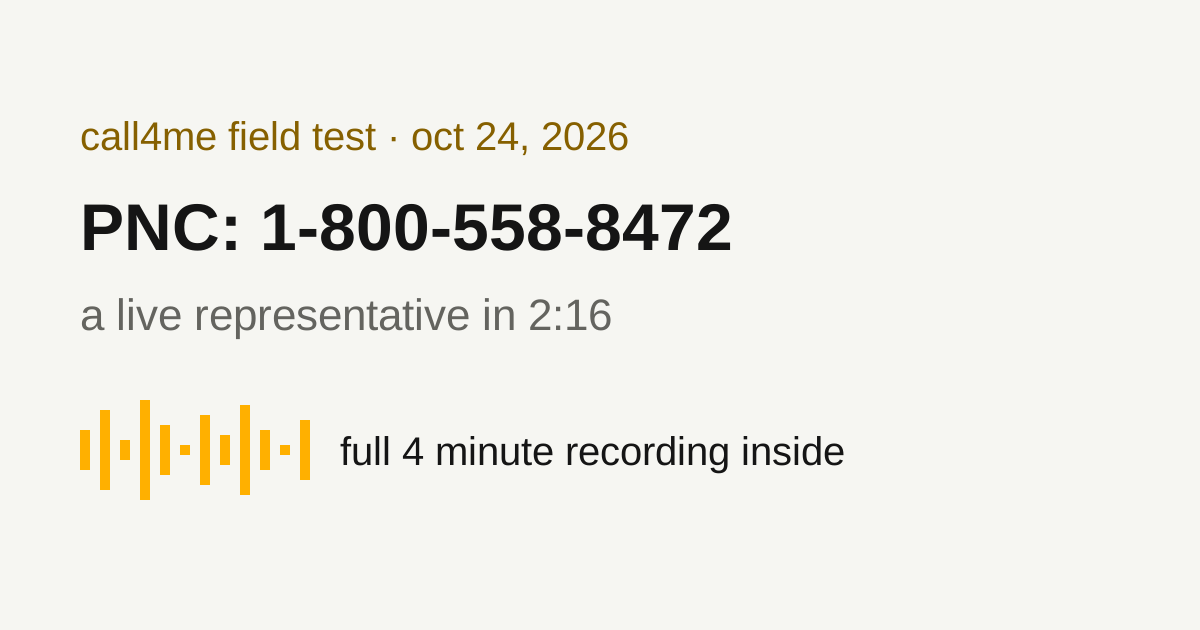
| PNC | 1-800-558-8472 | 2:16 | Card number, then first and last name |
| Wells Fargo | 1-800-642-4720 | 2:52 | Card or account number |
Times are from the start of each recording. Every number is the card line the bank lists on its own website for credit card service or disputes. Each linked page has the full recording, the phone tree and the transcript.
Four of the five representatives answered general questions. Discover's billing disputes representative wouldn't say anything without an account: "I wouldn't be able to provide any information unless I'm able to pull up an account."
What they told us about timing:
| Bank | How long to resolve, per the representative | Provisional credit, per the representative |
|---|---|---|
| Chase | "In most cases, within 30 days" | "In some cases" |
| Capital One | Handled by "our other specialist team" | Yes, "up to three business days" to post |
| PNC | "Two to three billing cycles" | "Not yet. Just after the investigation" |
| Wells Fargo | "60 days" | "Yes, ma'am, they will" |
How long you have to dispute a charge
Three of the representatives didn't mention a deadline at all. We asked each one how long after a charge someone can dispute it:
- Wells Fargo: "No, ma'am," there's no time limit.
- Capital One: "so long as it is visible on our end."
- Chase: "As long as it's not pending."
The banks' own websites say otherwise. Chase's dispute page says to submit "within 60 days of the transaction first appearing on your statement." Capital One's dispute page says "ideally within 60 days of the statement date." Federal law sets the same clock:
- Credit cards: a billing error notice must be received "no later than 60 days after the creditor transmitted the first periodic statement that reflects the alleged billing error" (Regulation Z, 12 CFR 1026.13(b)). The FTC's guide Using Credit Cards and Disputing Charges says to send it "so that it reaches the issuer within 60 days after the first bill with the error was sent to you."
- Debit cards: the bank must act on an error notice "received by the institution no later than 60 days after the institution sends the periodic statement" on which the error first appears (Regulation E, 12 CFR 1005.11(b)).
A bank may take a dispute after 60 days as a courtesy, and card network rules have their own windows. But after 60 days you're relying on the bank's goodwill, not the law.
Credit card vs debit card disputes
The two run under different laws, and the differences matter most when money is missing from your checking account.
| Credit card | Debit card | |
|---|---|---|
| The rule | Fair Credit Billing Act, Regulation Z | Electronic Fund Transfer Act, Regulation E |
| Deadline | 60 days after the first statement showing the error | 60 days after the statement showing the error |
| How to tell them | In writing, for your billing error rights. A call is a good start | By phone or in writing. The bank can ask for written confirmation within 10 business days |
| The money while they investigate | You don't have to pay the disputed amount, and they can't try to collect it | The money is gone from your account until they credit it |
| Provisional credit | Not required | Required if the bank takes more than 10 business days |
| How long they get | Acknowledge in 30 days, resolve within 2 billing cycles, 90 days at most | 10 business days, or up to 45 days with a provisional credit (90 for point-of-sale debit, foreign and new-account transactions) |
| Your cap on unauthorized use | $50 | $50 if you report a lost or stolen card within 2 business days, up to $500 after that, unlimited for transfers after 60 days from the statement |
The details, from the regulations:
- Credit card timing. The card company must "mail or deliver written acknowledgment to the consumer within 30 days of receiving a billing error notice" and resolve it "within 2 complete billing cycles (but in no event later than 90 days)" (1026.13(c)). Meanwhile "the consumer need not pay (and the creditor may not try to collect)" the disputed amount (1026.13(d)(1)).
- Debit card timing. The bank has 10 business days to investigate. If it needs longer, up to 45 days, it must "provisionally credit" the account within those 10 business days (1005.11(c)). The 45 becomes 90 for debit card point-of-sale purchases, transfers not initiated within a state, and transfers in the first 30 days after the account's first deposit. On an unauthorized transfer, the bank can hold back up to $50 of the provisional credit.
- Debit: send the letter if asked. If the bank "requires but does not receive written confirmation within 10 business days of an oral notice," it doesn't have to give you the provisional credit (1005.11(c)(2)).
- Unauthorized use. Credit card liability "shall not exceed the lesser of $50" or what was charged before you told them (1026.12(b)). For debit, it's $50, $500 or unlimited depending on how fast you report (1005.6). For both, you can report "in person, by telephone, or in writing."
So PNC's "no provisional credit" answer fits credit card rules: the card company doesn't credit you, but you don't pay the disputed amount either. On a debit card, a long investigation without a provisional credit would be a problem. Chase's dispute page says its debit provisional credit "usually occurs within 48 hours but may take up to 10 business days." Wells Fargo's claims page says: "Within 10 business days, your claim will be resolved" or "your account will receive a temporary credit if additional investigation is needed."
Can you dispute a debit card charge?
Yes. Regulation E's list of errors includes "an unauthorized electronic fund transfer," "an incorrect electronic fund transfer," and computational or bookkeeping errors by the bank. Call the bank's debit or checking line, not the credit card line: Chase's representative told us "You'll have to contact the debit card department," and Wells Fargo lists separate debit claim numbers.
That list doesn't include "I didn't get what I paid for." Banks often still take those disputes to the merchant through the card network, but the federal debit deadlines above are written for errors and unauthorized use. For a purchase that went wrong, a credit card gives you more: under 1026.12(c), you may be able to refuse to pay for it if you made "a good faith attempt to resolve the dispute" with the merchant, the purchase was over $50, and it happened in your state or within 100 miles of your address.
Cash App Card: Cash App's own guide, What to do if you get scammed, says it offers "Zero Fraud Liability on unauthorized Cash App Card transactions reported within 60 days," and to report through the app. Its support number, 1-800-969-1940, is open daily 8 am to 9:30 pm Eastern. We've recorded calls to it: see the Cash App customer service number.
What happens when you dispute a charge
From the calls and the banks' pages:
- You verify your identity. Expect your card number, name, date of birth, and maybe your Social Security number or its last four. Capital One's representative listed exactly that.
- You explain the charge. Chase: "the amount and the details why you want to dispute it."
- They may ask for evidence. PNC: "All types of receipts," proof of a return, "pictures or videos." Capital One's page lists receipts, shipping info, photos and messages with the merchant.
- They contact the merchant. Chase will "call the merchant on your behalf." Capital One will "manage the communications with the merchant."
- You may get a temporary credit, depending on the bank and the card type (see above).
- You get a decision. For a credit card, the CFPB says that if the company agrees with you, the charge must come off your bill. If it disagrees, it must explain why in writing, with how much you owe and when it's due.
If the bank doesn't follow the rules, you can submit a complaint to the CFPB.
How call4me can make the call for you
call4me is a phone for your AI agent: your agent (Claude Code, Codex, ChatGPT) tells it what to get done and it makes the call. It works the phone menu and waits on hold, and when the bank needs the cardholder, it rings your phone: you press 1 to join, enter your card number or answer their questions yourself, and press * or hang up to hand the call back. call4me's instructions to agents say never to ask for or save a Social Security number, card number or password, so you give those to the bank yourself. See an AI that calls customer service for you, or the other companies we've called.
Have your agent make this call
If you use call4me, paste this into your agent:
Call [bank] at the number on the back of my card, [number], to dispute a charge on my [credit or debit] card. Ring me when it asks for my card number, Social Security number or date of birth so I can enter them myself, and ring me if the representative needs to verify me. Tell them: [merchant], [amount], charged on [date], and why: [what went wrong, and what the merchant said when I contacted them on (date)]. Ask whether I'll get a provisional credit and when, how long it will take, where to send a written dispute, and for a reference number. Don't give out my PIN or password, and don't agree to any other change on the account. Afterwards, remind me to send the written dispute within 60 days of the statement.